Monolithic vs. Microservices Architecture: Choosing the Right Approach
Related: Introduction to Microservices
Introduction: The Architecture Dilemma
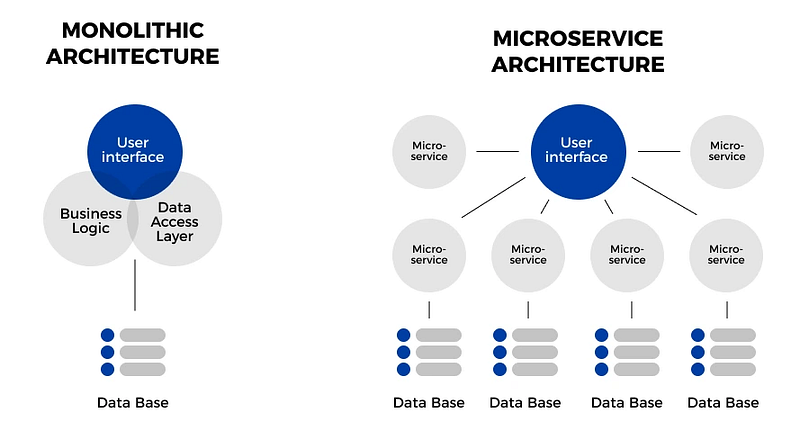
Imagine building a massive skyscraper where every floor is tightly connected — this is how monolithic applications work. Now, imagine constructing a city of independent buildings that interact but don’t rely on each other — this represents microservices architecture.
Choosing between monolithic and microservices is a crucial decision for developers and businesses. This guide will help you:
✅ Understand the differences between monolithic and microservices architectures
✅ Discover their pros and cons
✅ Explore real-world use cases
✅ Identify which approach is best for your project
Let’s dive in!
What is Monolithic Architecture?
A monolithic application is a single, unified codebase where all components — UI, business logic, and database — are tightly coupled.
Key Characteristics of Monolithic Architecture:
✔ Single Codebase: The entire application is built as one cohesive unit.
✔ Shared Database: All components use a single, centralized database.
✔ Tightly Coupled Components: Modules depend on each other, making updates complex.
✔ All-in-One Deployment: The entire application is deployed together.
Real-World Example: Traditional E-commerce Platforms
Many early e-commerce websites (before Amazon scaled with microservices) were built as monolithic applications. Every feature, from product listings to checkout, was bundled into a single system.
What is Microservices Architecture?
Microservices architecture divides applications into smaller, independent services that communicate via APIs. Each service is responsible for a specific business function, such as user authentication, payments, or inventory management.
Key Characteristics of Microservices Architecture:
✔ Independent Services: Each microservice operates separately and has its own database.
✔ Scalability: Services can be scaled independently based on demand.
✔ Flexibility: Different services can use different programming languages and frameworks.
✔ Resilience: If one service fails, the rest of the system remains operational.
Real-World Example: Netflix
Netflix switched to microservices to handle millions of simultaneous users streaming content. Their architecture includes separate services for video encoding, recommendations, and user authentication.
+===================+=====================================+========================================+
|      Feature      |       Monolithic Architecture       |       Microservices Architecture       |
+===================+=====================================+========================================+
| Codebase          | Single, unified codebase            | Multiple smaller codebases             |
+-------------------+-------------------------------------+----------------------------------------+
| Deployment        | Entire app deployed at once         | Independent service deployment         |
+-------------------+-------------------------------------+----------------------------------------+
| Scalability       | Hard to scale individual components | Services scale separately              |
+-------------------+-------------------------------------+----------------------------------------+
| Fault Isolation   | One failure can crash the whole app | Failures are contained within services |
+-------------------+-------------------------------------+----------------------------------------+
| Technology Stack  | Uniform for the whole application   | Different tech stacks per service      |
+-------------------+-------------------------------------+----------------------------------------+
| Development Speed | Slower due to dependencies          | Faster due to parallel development     |
+-------------------+-------------------------------------+----------------------------------------+
Related: Introduction to Microservices
Advantages of Monolithic Architecture
1. Simplicity
- Easier to develop, test, and deploy in early stages.
- Ideal for small projects or startups with limited resources.
2. Performance
- Monolithic applications often run faster because all components interact within the same process.
3. Easier Debugging
- Since everything is in one codebase, debugging and testing are straightforward.
4. Lower Initial Cost
- No need for complex API management or distributed infrastructure.
When to Use Monolithic Architecture?
✅ Small to medium-sized projects with limited features.
✅ Startups that need to launch quickly.
✅ When performance optimization is critical.
Advantages of Microservices Architecture
1. Scalability
- Services scale independently to meet demand.
- Ideal for high-traffic applications like e-commerce and streaming.
2. Faster Development
- Teams work on separate microservices in parallel, speeding up development.
3. Technology Flexibility
- Use different programming languages and databases for different services.
4. Improved Fault Tolerance
- A failure in one service doesn’t crash the entire system.
When to Use Microservices Architecture?
✅ Large-scale applications needing high scalability.
✅ Businesses that require continuous integration and deployment (CI/CD).
✅ Systems where fault tolerance is essential.
Challenges of Each Architecture
Monolithic Architecture Challenges
🚧 Slow Deployment — Updating one component requires redeploying the whole system.
🚧 Limited Scalability — Can’t scale individual features separately.
🚧 Harder Maintenance — Over time, the codebase becomes difficult to manage.
Microservices Architecture Challenges
🚧 Complexity — Requires managing multiple services, APIs, and databases.
🚧 Latency — Communication between microservices can introduce delays.
🚧 Security Risks — More endpoints = higher security risks.
Real-World Use Cases
+==========+==============================+========================================================+
| Company  | Monolithic or Microservices? |                          Why?                          |
+==========+==============================+========================================================+
| Facebook | Monolithic (Hybrid)          | Optimized for fast UI updates                          |
+----------+------------------------------+--------------------------------------------------------+
| Netflix  | Microservices                | Handles millions of simultaneous users                 |
+----------+------------------------------+--------------------------------------------------------+
| Amazon   | Microservices                | Scales services like payments and inventory separately |
+----------+------------------------------+--------------------------------------------------------+
| Etsy     | Monolithic → Microservices   | Transitioned for better scalability                    |
+----------+------------------------------+--------------------------------------------------------+
Monolithic vs. Microservices: Which One Should You Choose?
+========================+==========================+
|      Project Type      | Recommended Architecture |
+========================+==========================+
| Small startup MVP      | Monolithic               |
+------------------------+--------------------------+
| Enterprise application | Microservices            |
+------------------------+--------------------------+
| E-commerce platform    | Microservices            |
+------------------------+--------------------------+
| Simple blog or website | Monolithic               |
+------------------------+--------------------------+
| Real-time analytics    | Microservices            |
+------------------------+--------------------------+
Hybrid Approach: Some companies start monolithic and transition to microservices as they grow.
FAQ: Monolithic vs. Microservices
Q: Can I migrate from monolithic to microservices?
A: Yes, but it requires gradual refactoring and breaking components into services.
Q: Is microservices always the best choice?
A: No! For small apps, a monolithic approach is often faster and cheaper.
Q: How do microservices communicate?
A: Via REST APIs, gRPC, or message brokers like Kafka.
Conclusion: Making the Right Choice
Both monolithic and microservices architectures have their strengths and weaknesses. The best choice depends on your project size, scalability needs, and resources.
✅ For small projects — Start with monolithic.
✅ For large, scalable systems — Use microservices.
✅ For hybrid needs — Start monolithic and transition over time.
Got questions? Drop them in the comments! 👇
Comments
Post a Comment